Claude Code Skills for n8n: When Skills Beat Nodes (2026)


Table of Contents
- Introduction
- What are Claude Code skills and how do they work?
- How do Claude Code skills compare to n8n for automation?
- When can Claude Code skills replace n8n workflows?
- What are the best use cases for Claude Code skills?
- How do you build and iterate on skills?
- What are the technical limits of Claude Code skills?
- Frequently Asked Questions (FAQs)
Introduction
Looking for n8n vs Claude Code? Start with Can Claude Code replace n8n? — the architecture guide. This post goes deeper on Claude Code Skills only: when reusable skill instructions beat n8n nodes for cognitive work.
People search claude code n8n skills and n8n skills for claude code because they want Claude to handle judgment-heavy steps without redrawing a workflow graph every time requirements shift.
What are Claude Code skills and how do they work?
A skill is a set of instructions packaged as a simple folder that teaches Claude how to handle specific tasks or workflows. Think of it as a reusable knowledge repository that Claude can load and apply consistently across different projects and sessions. Unlike one-off prompts that live only in a single chat, skills persist and can be invoked whenever they are relevant, whether you are in Claude.ai, Claude Desktop, or using the API.
The main idea is portability and consistency. You define a skill once, and it becomes available everywhere Claude runs. A skill created in Claude Code can be used on Claude.ai or Claude Desktop without change. That cross-platform availability reduces the fragmentation that often comes with automation: one set of instructions, one place to update.
Skills work especially well for repeatable workflows: turning specs into frontend designs, running research with a consistent method, producing documents that follow your style guide, or orchestrating multi-step processes. They combine natural language instructions with executable code. Claude runs in an environment that includes a bash shell with Python and Node.js, so skills can run terminal commands, execute scripts, and modify files, not just suggest text.
Under the hood, skills use a three-level structure. The first level is YAML frontmatter that is always loaded into Claude's system prompt. It tells Claude when the skill is relevant without loading the full body. The second level is the skill body itself, loaded only when Claude decides the skill applies to the current task. That keeps context efficient: irrelevant skills do not consume tokens. The third level can include linked files, Python scripts, or other code that Claude runs to get the job done.
Skills can be invoked by Claude automatically. Unlike slash commands that require you to type something, Claude can choose to apply a skill when it recognizes a relevant situation. Skills are stored in markdown files with frontmatter, either globally in ~/.claude/skills/ or inside a project at project/.claude/skills/. That structure keeps things predictable and easy to share.
How do Claude Code skills compare to n8n for automation?
n8n is a workflow orchestration platform. You build automated processes by placing nodes on a canvas, connecting them with edges, and configuring triggers and parameters. Workflows run on a fixed path: schedules, webhooks, or events start the flow, and data moves step by step through the graph. n8n excels at connecting systems: CRM to email, database to database, or triggering notifications across services. It has a large library of integrations, handles auth and retries, and gives you audit trails that many operations and compliance teams rely on.
The core difference is flexibility versus rigidity. n8n workflows are largely deterministic. Once you design a flow, it follows the same path every run. If something happens that the workflow was not built for, it typically errors or needs manual handling. Changing behavior means editing the graph and redeploying. There is no built-in "understand and adapt" step.
Claude Code skills are the opposite. You describe what you want in natural language and principles; Claude reasons about how to achieve it. If the input or context changes, Claude can adjust without you redrawing a graph. Skills also bundle execution: Claude can run code, call tools, and make decisions inside one coherent context. That makes them a good fit for tasks that need judgment, interpretation, or variation.
Another difference is where logic lives. In n8n, logic is in the structure of the graph and the config of each node. In skills, logic is in the instructions and in Claude's reasoning. Updating a skill is often a text edit and a refresh; updating an n8n workflow can mean moving nodes, adding branches, and re-testing the whole flow.
That said, n8n has strengths skills do not replace. It gives you visual, explicit workflows that are easy to audit and hand off. It has deep, pre-built integrations for hundreds of apps. Its execution model is predictable and traceable, which matters for compliance and ops. For straight-through, high-volume integrations (sync this CRM to that sheet, run this every hour), n8n is often the simpler and more reliable choice.
When can Claude Code skills replace n8n workflows?
Claude Code skills are a strong replacement when the work is cognitive rather than purely connective. If the task involves reading, deciding, summarizing, or creating content, skills tend to shine. If the task is "when X happens, call API A then API B and store the result," n8n is usually the better fit.
Example: turning changelogs into newsletters. An n8n workflow can fetch changelog data and push it into an email template. But if you want to read the changelog, decide what matters for which audience, adjust tone, and write a short narrative, that is a job for Claude. A skill can encode how you want changelogs summarized and styled; Claude does the reading and writing. Another example: turning demo notes into stakeholder emails. Claude can read unstructured notes, pick out the points that matter per recipient, and draft personalized emails. In n8n you would need custom logic or external services to approximate that.
Skills also help when the path is not fixed. Imagine a flow where you research a topic, analyze findings, fact-check, format to brand guidelines, and run a quality checklist. In n8n that becomes a long chain of nodes with branches for errors and edge cases. Each new requirement or guideline often means more nodes and more branches. With a skill, you describe the outcome and the standards; Claude handles the steps and can adapt when the input or the guidelines change.
Skills are also useful when you need to work with systems that do not have an n8n node. If you must process documents, extract information, and trigger actions based on content, Claude can do that with code and tools. In n8n you would rely on custom webhooks or code nodes and still lack the same level of language understanding.
So: use skills when the workflow is decision-heavy, content-heavy, or variable. Use n8n when the workflow is well-defined, integration-heavy, and you want a visible, auditable graph.
What are the best use cases for Claude Code skills?
Research and analysis is one clear use case. You can build a research skill that uses slash commands, scripts, and sub-agents to stay on top of new papers or news. Claude can spawn sub-agents to search multiple sources in parallel, then synthesize and highlight what matters. n8n can pull feeds and send them somewhere, but it cannot read and judge relevance the way Claude can.
Documentation is another. A project-docs skill can combine commands, other skills, and context so Claude keeps docs up to date. It can read existing docs, notice gaps from recent changes, and update or add sections. When the project evolves, the same skill adapts; with n8n you would redesign the workflow.
Task and project management fits well too. A skill can use context, commands, and scripts to manage daily tasks. Claude can see dependencies and deadlines, work across projects, and suggest better ways to organize work. That kind of contextual reasoning is hard to encode in a static n8n graph.
Frontend and design generation is a different angle. A frontend-design skill can take specs and produce production-ready UI that follows your style guide and brand. The skill can embed templates and quality checks; Claude generates the code and applies the standards. No external design tool is required.
Personalization is another strong use case. Voice DNA-style skills capture how you write (tone, structure, vocabulary) so that Claude's output sounds like you. Combined with an audience profile, you get consistent, on-brand content. That is hard to do with n8n alone, which does not "understand" voice or audience in the same way.
How do you build and iterate on skills?
You can create skills using the skill-creator skill, available in Claude.ai via the plugin directory or in Claude Code. If you have a few main workflows in mind, you can go from description to a first skill relatively quickly. The skill-creator can generate skills from descriptions, review existing skills and suggest improvements, and guide you through iterations.
Skills are defined in markdown with YAML frontmatter. The frontmatter states when and why Claude should use the skill; the body holds the detailed instructions. You can attach scripts or other files so Claude can execute code as part of the skill. Validation is part of the process: you can ask the skill-creator to assess a skill and recommend changes before you rely on it. That is a real advantage over building n8n workflows where quality depends entirely on the designer.
Skills can be shared across a team. Once a skill is defined, it can live in a shared directory or repo so everyone uses the same instructions. That builds organizational knowledge that improves as people refine the skill over time. You iterate by editing the skill text and possibly the linked code, rather than by changing a visual graph.
What are the technical limits of Claude Code skills?
Skills run inside Claude's environment and inherit its limits. Token usage is the main one. If a skill uses multiple sub-agents (for example, several parallel research agents), token consumption can grow quickly. A single research run with multiple sub-agents and many searches can reach hundreds of thousands of tokens. For some teams that is fine; for others it is a real cost compared to n8n's more predictable subscription model.
Claude's capabilities also set the ceiling. If you need to talk to a system that has no MCP server and no simple API, you may need workarounds or custom code. n8n's integration library, while not universal, is very broad for standard business software, so for "connect these two products" jobs, n8n can still be easier.
Audit and compliance differ too. n8n logs each step and each payload in a way that is easy to inspect. Claude gives you conversation history and tool use, but the internal reasoning is not fully transparent. For heavily regulated use cases, that can matter. Anthropic is working on clearer explanations of Claude's decisions, but today n8n is often stronger for strict audit requirements.
Skills work best when combined with MCP (Model Context Protocol) where it makes sense. MCP gives Claude live access to data and tools; skills teach Claude how to use them. For example, a compliance skill can describe how to apply rules, and an MCP server can expose transaction data so Claude can fetch it and apply those rules. Together they get close to what you might have built in n8n, but with more flexibility in the reasoning layer.
Frequently asked questions
Quick answers on the topics covered in this article.
There is no official "n8n skill" product from Anthropic. Searchers usually mean one of three things: (1) a Claude Code Skill that teaches Claude how to design or debug n8n workflows, (2) using n8n's Anthropic node to call Claude from a workflow, or (3) community templates that pair n8n orchestration with Claude reasoning steps. All three are valid hybrid patterns.
Common patterns: call Anthropic's API from an n8n HTTP Request node, use n8n's native Anthropic integration where available, or trigger a webhook that Claude Code helped you build. n8n owns schedules, retries, and credentials; Claude owns judgment-heavy steps. Validate model output before writing to CRMs or finance tools.
No. Claude Code and Skills accelerated how fast teams build automation, but production orchestration — webhooks, fan-out, error handling, connector catalogs — still belongs in tools like n8n. Claude replaces rigid nodes for cognitive work; it does not replace an execution engine.
Claude Code skills are reusable instruction packages (stored as markdown with optional code) that teach Claude how to perform specific tasks or workflows. They persist across sessions and can be used in Claude.ai, Claude Desktop, and the API so you define once and use everywhere.
They can replace n8n for workflows that depend on understanding, decision-making, or content creation (e.g. research, docs, emails, summaries). For high-volume, deterministic integrations (sync systems, scheduled pipelines), n8n is often simpler and easier to audit.
Skills are natural-language instructions plus optional code; Claude decides when to use them and how to adapt. n8n workflows are fixed graphs of nodes and edges that run the same path each time. Skills are flexible and cognitive; n8n is explicit and connective.
Use skills when the task involves reading, writing, judging, or varying behavior (e.g. turning changelogs into newsletters, keeping docs up to date, managing tasks with context). Use n8n when the task is well-defined integration or scheduled data movement with a clear path.
They are separate systems. You can use both: n8n for integrations and event-driven pipelines, and Claude (with skills) for steps that need reasoning or content. Some teams trigger Claude from n8n via API for hybrid workflows.
Strong use cases include research and synthesis, documentation updates, task and project management, frontend or content generation from specs, and personalization (e.g. voice and audience). Any repeatable workflow that benefits from judgment and adaptation fits well.
Use the skill-creator skill in Claude.ai or Claude Code. Describe the workflow or task; the skill-creator helps you generate the markdown and frontmatter. You can add scripts and iterate with the same tool by asking it to review and improve the skill.
Cost models differ. n8n is typically a fixed subscription. Skills run on Claude and consume tokens; heavy use (e.g. many sub-agents or long context) can add up. For simple, high-volume integrations, n8n can be cheaper; for cognitive work, skills can replace multiple tools and still be cost-effective.
Yes. Claude runs in an environment with a bash shell, Python, and Node.js. Skills can include scripts that Claude executes. For APIs, Claude can use MCP servers or code in the skill to make HTTP requests and process responses.
Limitations include token usage (and cost) for complex or parallel runs, dependence on Claude's current capabilities and MCP support, and less transparent audit trails than n8n for strict compliance. For pure integration and auditability, n8n is often the better fit.
Share this article
Related workflows
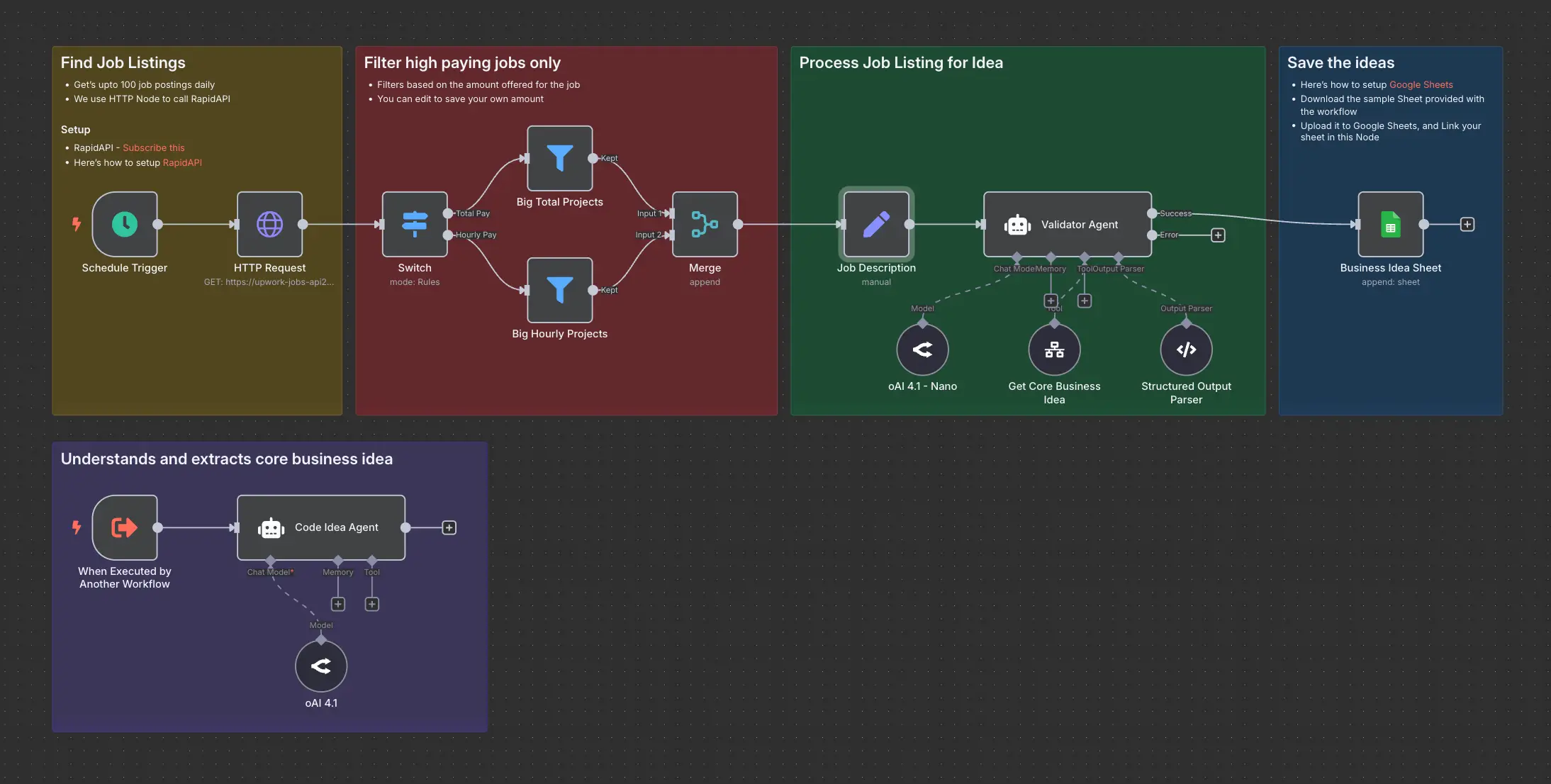
Daily Validated Business Ideas using n8n and Upwork
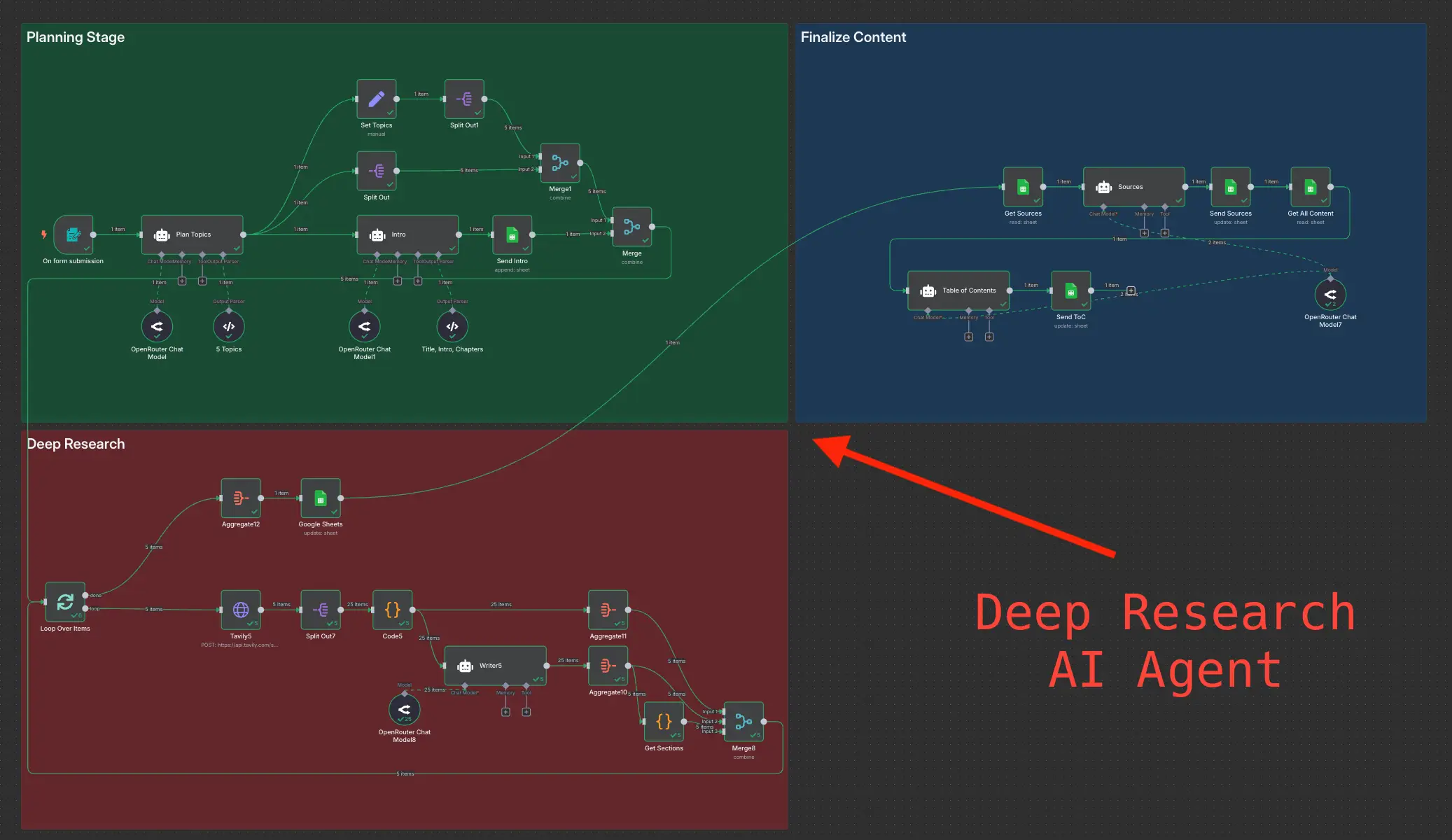
Deep Research using n8n automation to generate report using Tavily