Can Claude Code Replace n8n? Skills, Workflows & Hybrid Stacks

Table of Contents
- Introduction
- What is n8n and when is visual orchestration the right default?
- What is Claude Code if it is not a workflow canvas?
- Can Claude Code replace n8n for real business workflows?
- What are Claude Skills and how do they compare to n8n nodes?
- How should n8n and Claude Code work together in a hybrid stack?
- n8n vs Claude Code: how do you choose without regret?
- What limits should you plan for before you commit?
- Frequently Asked Questions (FAQs)
Introduction
If your Search Console export is a wall of variants on the same question, you are not alone. People type n8n vs Claude Code, Claude Code vs n8n, n8n or Claude Code, and can Claude Code replace n8n because the category names sound like competitors even when the products are not the same shape.
Here is the direct answer you probably wanted before the scroll: Claude Code does not replace n8n for the kind of automation most teams mean when they say workflows - scheduled jobs, fan-out integrations, retries, queueing, and a catalog of maintained connectors. Claude Code is a coding agent that helps you write and refactor software, including the glue code that could back an automation. n8n is an orchestration engine that runs those graphs in production with operational affordances you should not hand-wave away.
That does not make the comparison useless. It reframes it. The interesting decision is not which logo wins. It is where you want the source of truth to live for triggers, state, credentials, and change management, and where you want generative help to speed up design, implementation, and maintenance. This article walks through definitions, the replacement question, Skills versus nodes, hybrid patterns, and practical limits - tuned to the queries people actually type.
If you are optimizing for clicks from search, you deserve more than a slow ramp. The queries behind n8n or Claude Code are usually purchase and architecture decisions disguised as brand battles. Someone is trying to pick a default for the next quarter, justify a stack to a manager, or understand why their favorite creator keeps pairing the two names. The through-line is simple: orchestration and coding agents solve different jobs, and the best results usually assume both exist in your toolchain, even if only one shows up on the architecture diagram you share externally.
n8n vs Claude Code: choose this if…
| Your goal | Pick | Skip |
|---|---|---|
| Scheduled syncs, webhooks, retries, connector catalog | n8n | Claude Code alone |
| Build/refactor the glue code and services | Claude Code | Expecting a workflow canvas |
| Judgment-heavy steps inside a production pipeline | Hybrid (n8n runs graph; Claude API at nodes) | Replacing n8n with chat |
| Cognitive, variable content work (research, docs) | Claude Skills | Rigid n8n node chains |
| Team needs visual audit trail + non-dev edits | n8n | Code-only automation |
For Skills-only depth, see Claude Code Skills for n8n workflows. For editor choice (Cursor vs Claude Code terminal vs VS Code extension), see Cursor vs VS Code vs Claude Code.
What is n8n and when is visual orchestration the right default?
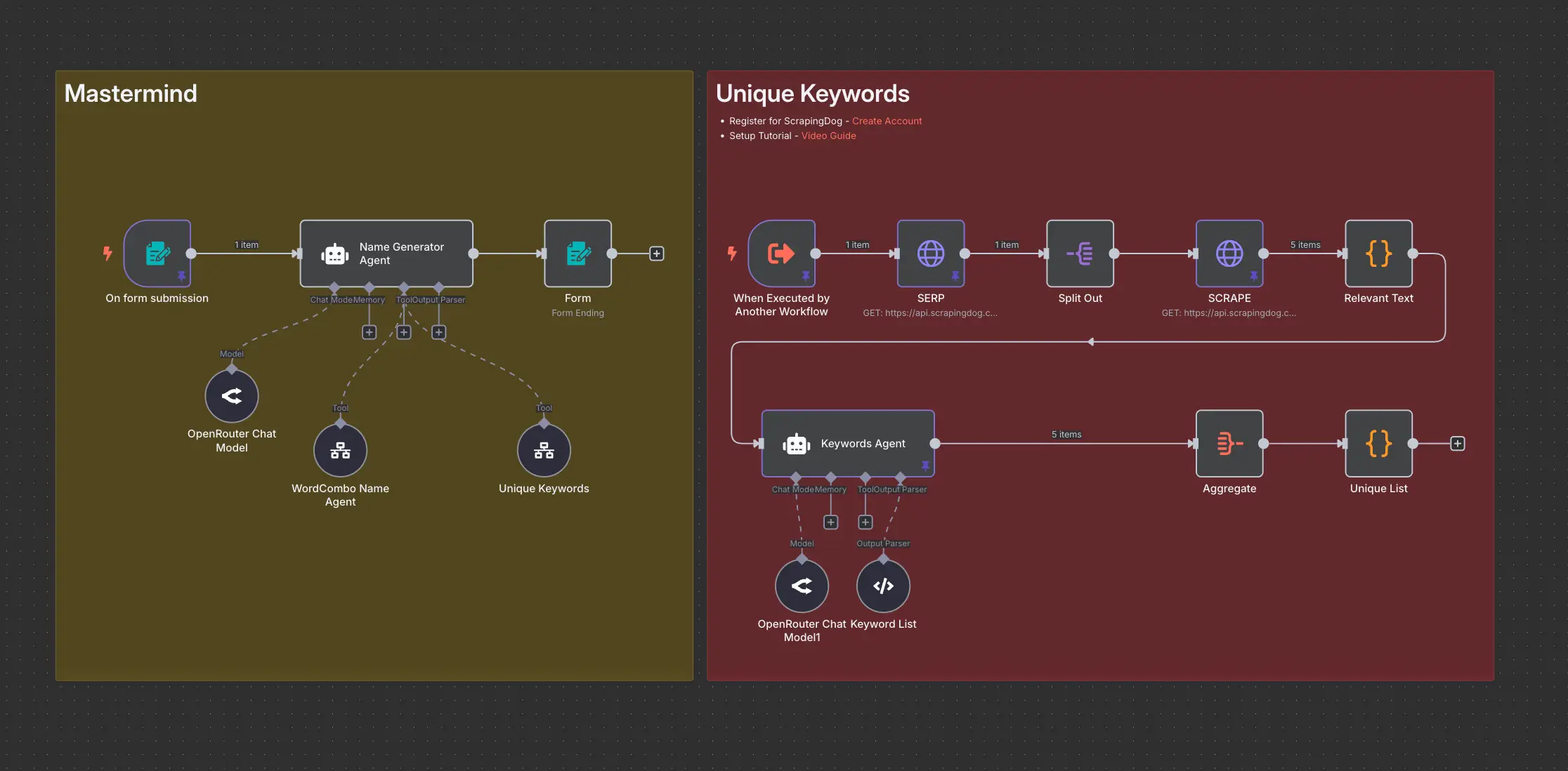
n8n is workflow automation software. You model work as a graph: triggers (webhooks, schedules, polling), steps (HTTP calls, databases, SaaS APIs), branching, error handling, and retries. The product is built around the idea that integrations are repeatable units with predictable inputs and outputs, and that operators need visibility when something fails at step seven of fourteen.
That last point matters more than marketing pages admit. Production automation is less about the happy path and more about partial failures, idempotency, replays, and access control. A mature n8n setup gives you a shared place to store credentials, a visual trace of executions, and patterns teams can reuse without requiring every stakeholder to read Python stack traces.
If your problem sounds like "when a row changes, notify three systems, dedupe, and alert if latency spikes," you are squarely in orchestration territory. If your problem sounds like "every morning, reconcile two reports with fuzzy matching rules nobody documented," you still might end up in orchestration - but you may also need serious custom logic. That is where Claude Code often enters, not as a substitute for n8n, but as an accelerator for the code and specs around it.
Why do self-hosted and cloud n8n still win for operations teams?
Self-hosting n8n is a deliberate trade. You take on patching, backups, and scaling, and you gain data residency and cost predictability for high execution volume. Cloud n8n trades some control for speed and managed uptime. Neither choice turns n8n into Claude Code, and that is the point: operations teams want a system where executions are observable, secrets are scoped, and changes are reviewable.
If your organization already standardizes on n8n for integrations, the winning move is rarely to rip the orchestration layer out because a coding agent appeared. It is to tighten the boundaries: which workflows are allowed to call large language models, what logging is mandatory, and how prompts and tools are versioned.
There is also a team dynamics angle that search volume will never fully capture. Visual graphs lower the activation energy for analysts, marketers, and ops leads to participate in automation. Code-first stacks often centralize power in engineers, which can be appropriate - but it is a different organization, not a free upgrade. When people ask n8n vs Claude Code, part of what they are really asking is who is allowed to change production behavior and how much transparency the next incident review will have.
What is Claude Code if it is not a workflow canvas?
Claude Code is Anthropic's agentic coding tool: you work in your repo, describe intent, and the agent proposes edits, runs commands, and iterates like a teammate who never sleeps. It is not a drag-and-drop integration canvas. It does not ship with a first-class scheduler, a universal connector catalog, or a turnkey execution history UI comparable to a workflow engine's run log.
That distinction is where much confusion comes from. If you ask Claude Code to "build an automation," you will usually get code - scripts, services, or refactors - not a hosted, monitored workflow graph. You still decide where that code runs, how it is deployed, how credentials are injected, and how you observe failures.
The upside is flexibility. Code can express logic that is painful to model as nodes. The downside is ownership. You inherit software engineering responsibilities even when the first draft was generated quickly.
How does Claude Code change the way you ship automation code?
In practice, teams use Claude Code to bootstrap workers, refactor brittle scripts, generate OpenAPI clients, draft n8n workflow JSON for import, or write the serverless handler behind a webhook. It shines when the task is inherently textual and repository-shaped: migrations, tests, documentation, and repetitive refactors.
It is a poor fit as a wholesale replacement for a central integration hub unless you are willing to run and maintain whatever the agent produces. For many businesses, that is a bigger commitment than paying for orchestration credits or hosting a workflow engine.
Picture a concrete scenario so the abstraction does not float away. Suppose you need a nightly job that pulls from three SaaS tools, normalizes fields, and writes to a warehouse. n8n gives you a straight line from trigger to connectors to transformation nodes, with a run history you can screenshot when finance asks what happened on Tuesday. Claude Code can help you draft the transformation logic, generate a small TypeScript worker, or clean up a messy script - but someone still wires deployment, secrets rotation, and monitoring. If you skip n8n entirely, you are not avoiding complexity. You are moving it into repositories and runbooks.
Can Claude Code replace n8n for real business workflows?
Sometimes people ask this question literally. More often, they mean one of three different questions: Can I stop paying for orchestration? Can I build faster? Can I consolidate tools?
If you mean stop paying for orchestration, the honest answer is usually no, unless your automation is narrow enough to live entirely in a single service you control and you are comfortable operating it as software. If you mean build faster, the answer is often yes, because Claude Code accelerates implementation. If you mean consolidate, the answer is sometimes, but consolidation is not free - it shifts work from workflow configuration to engineering operations.
What does replace even mean for triggers, retries, and integrations?
Be precise about what n8n gives you. Triggers are not just "code that runs on a timer." They are delivery semantics: at-least-once webhooks, cron with timezone rules, backoff, dead-letter behavior, and integration-specific quirks. Retries are not just try or except. They are policies tied to idempotency keys and downstream rate limits.
If you "replace" n8n with a script Claude Code wrote, you still must implement or borrow those operational behaviors. Many teams discover they recreated a worse version of a workflow engine inside a monolith. That is not a win. It is a migration tax.
This is why searches like Claude Code vs n8n workflow automation often resolve to scope, not superiority. Workflow automation, in the enterprise sense, includes audit trails, access roles, and change control. A coding agent can participate in that story, but it does not automatically produce it. When in doubt, list your non-negotiables on paper: GDPR, SOC2 expectations, on-call playbooks, and the minimum debugging story you will accept at 2 a.m. If half the list maps to features n8n already ships, you have your answer.
What are Claude Skills and how do they compare to n8n nodes?
Anthropic's Skills are packaged capabilities you attach to Claude: instructions, resources, and optional code that teach the model how to perform a repeatable job with fewer ad-hoc prompts.
Anthropic's Skills are packaged capabilities you attach to Claude: instructions, resources, and optional code that teach the model how to perform a repeatable job with fewer ad-hoc prompts. They are a product-level mechanism for consistency and reuse inside Claude clients, not a public integration marketplace like n8n's node catalog.
n8n nodes are integration adapters maintained for a specific workflow runtime. They encode auth patterns, field mapping, and API endpoints so a builder can connect systems without writing a client library by hand.
Skills and nodes solve different layers of the stack. A Skill might teach Claude how to reason about your company's incident checklist. A node actually executes the Slack post or database write inside n8n's execution model. You can use both: Skills to standardize how humans and agents prepare work, nodes to execute and monitor it.
What do people mean by n8n skills for Claude in search results?
Search queries mash terms together. When people type Claude n8n skills or n8n Claude skills, they are usually looking for one of four things: Skills in the Anthropic sense, MCP servers or tool connectors that expose n8n to an agent, prompt packs or courses that teach Claude how to work with n8n exports, or templates for HTTP calls to Claude's API from a workflow.
Third-party educators and creators sometimes sell structured material under names that echo both ecosystems. Treat those like any training product: verify what you are buying (videos, JSON templates, MCP tooling) and whether it matches your security model. The underlying pattern is stable even when the brand names vary: Claude helps you think and draft; n8n helps you run and observe.
How should n8n and Claude Code work together in a hybrid stack?
The stack that maps cleanly to most real businesses is n8n as the integration and execution backbone plus Claude Code as the implementation accelerator, with optional API calls to Claude at steps that need language reasoning.
A concrete pattern: keep schedules, webhooks, CRM updates, and ticketing integrations in n8n. When a step needs summarization, classification, or draft generation, call Claude through a supported pattern (for example, an HTTP node to Anthropic's API or a dedicated integration node if you use one), then continue the graph with structured outputs validated by your own rules.
Another pattern: use Claude Code in development to generate or refactor custom nodes, sub-workflows, or external workers n8n calls via webhook. You still deploy through normal engineering channels, but you ship faster.
Some teams also experiment with MCP-style tool wiring so an agent can interact with systems through a controlled surface area. That can be powerful for internal tools, but it is easy to underestimate policy work: who can register a tool, how tokens are scoped, and what happens when the model requests an action that is allowed by code but not by your risk appetite. n8n remains a natural place to enforce hard gates because the graph is explicit and reviewable.
How do you call Claude from n8n safely and reliably?
Treat model calls like any other external dependency: pin model names, log prompts and outputs with redaction, enforce JSON schema or parser gates before you write to systems of record, and budget tokens so a spike does not take down unrelated workflows. Add guardrails for PII and secrets so a hurried prompt edit does not leak credentials into logs.
If you need tool use or multi-step reasoning inside Claude, be explicit about stop conditions and human approvals for high-risk actions like refunds or mass emails. The failure mode you are preventing is not "the model was wrong once." It is "the model was wrong at scale because automation amplified it."
n8n vs Claude Code: how do you choose without regret?
Use n8n-first when non-engineers must maintain flows, when connector breadth matters more than bespoke logic, when you need strong execution visibility, or when integrations are mostly stable API calls with well-known schemas.
Use Claude Code-first when the problem is primarily software in a repo: building services, refactoring pipelines, or generating substantial code artifacts. Expect to add orchestration later if the world insists on schedules and webhooks.
Use both when you are serious: n8n runs production graphs, Claude Code speeds implementation, and Claude API calls sit behind validation at specific steps. That combination matches how modern teams actually work, even if LinkedIn threads frame it as a cage match.
What limits should you plan for before you commit?
n8n is not magic. Complex branching can become hard to read. Custom code nodes shift you back into engineering discipline. Cloud pricing can surprise you if executions explode. Self-hosting shifts the burden to your platform team.
Claude Code is not magic either. Generated code needs review, tests, and deployment strategy. Model behavior changes over time; prompts and Skills should be versioned like config. Anything that touches money, compliance, or customer promises needs human-readable policies and automated checks, not vibes.
If you came from Search Console with zero clicks, the meta-lesson is the same as always: align the title and description with the question people typed. If they want a verdict, put the verdict early. If they want a skills map, define terms before the analogy stretches. This post is written that way on purpose.
For the Skills-specific angle (what n8n skills for Claude Code means, when skills replace nodes), see Claude Code vs n8n: Skills and when each wins. For editor choice (Cursor vs Claude Code terminal vs VS Code extension), see Cursor vs VS Code vs Claude Code.
Frequently asked questions
Quick answers on the topics covered in this article.
Not for typical multi-system workflow automation. n8n provides orchestration, connectors, scheduling, and execution history. Claude Code helps you write and change the software around those systems. You can shrink n8n's role only if you willingly operate custom services that replicate what orchestration already gives you.
n8n is a workflow automation engine with nodes and runs. Claude Code is a coding agent that works in your repository to implement or refactor software. They overlap in spirit - both help you move faster - but they do not occupy the same layer of the stack.
Skills are Anthropic's mechanism for reusable Claude capabilities. They are not n8n nodes. In practice, teams combine Skills (for consistent prompting and procedures) with n8n (for execution) or use Claude to draft n8n workflow JSON that humans review before import.
Common patterns include calling Anthropic's API from an HTTP Request node, using a dedicated integration if available in your stack, or running a worker Claude Code helped you build that n8n triggers via webhook. Always validate model outputs before writing to CRMs, finance tools, or ticketing systems.
Better is the wrong word. n8n is better for operational orchestration across many integrations. Claude Code is better for accelerating code-level work. Most mature setups use n8n to run production graphs and Claude tooling to build faster.
Yes, as long as you treat generated JSON or scripts as proposals. Import carefully, test in a sandbox, and review credentials, error handling, and idempotency. The speed gain is real; the responsibility for production safety is still yours.
Because both touch automation headlines in 2026, and because "vs" is how buyers compress a messy decision into one tab. The useful framing is complementary roles, not a single winner.
Only if your constraints require it. Self-hosting is about data residency, cost at scale, and control - not about Claude. Many teams run cloud n8n and still call Claude APIs with strict logging and secrets handling.
If your goal is reliable integrations without becoming a full-time engineer, start with n8n. If your goal is shipping custom services and you already live in Git, start with Claude Code - then add orchestration when schedules and webhooks multiply.
n8n executes and monitors integrations; Claude Code accelerates building and refactoring; optional Claude API calls add language intelligence at specific steps with validation guardrails.
Share this article
Related workflows
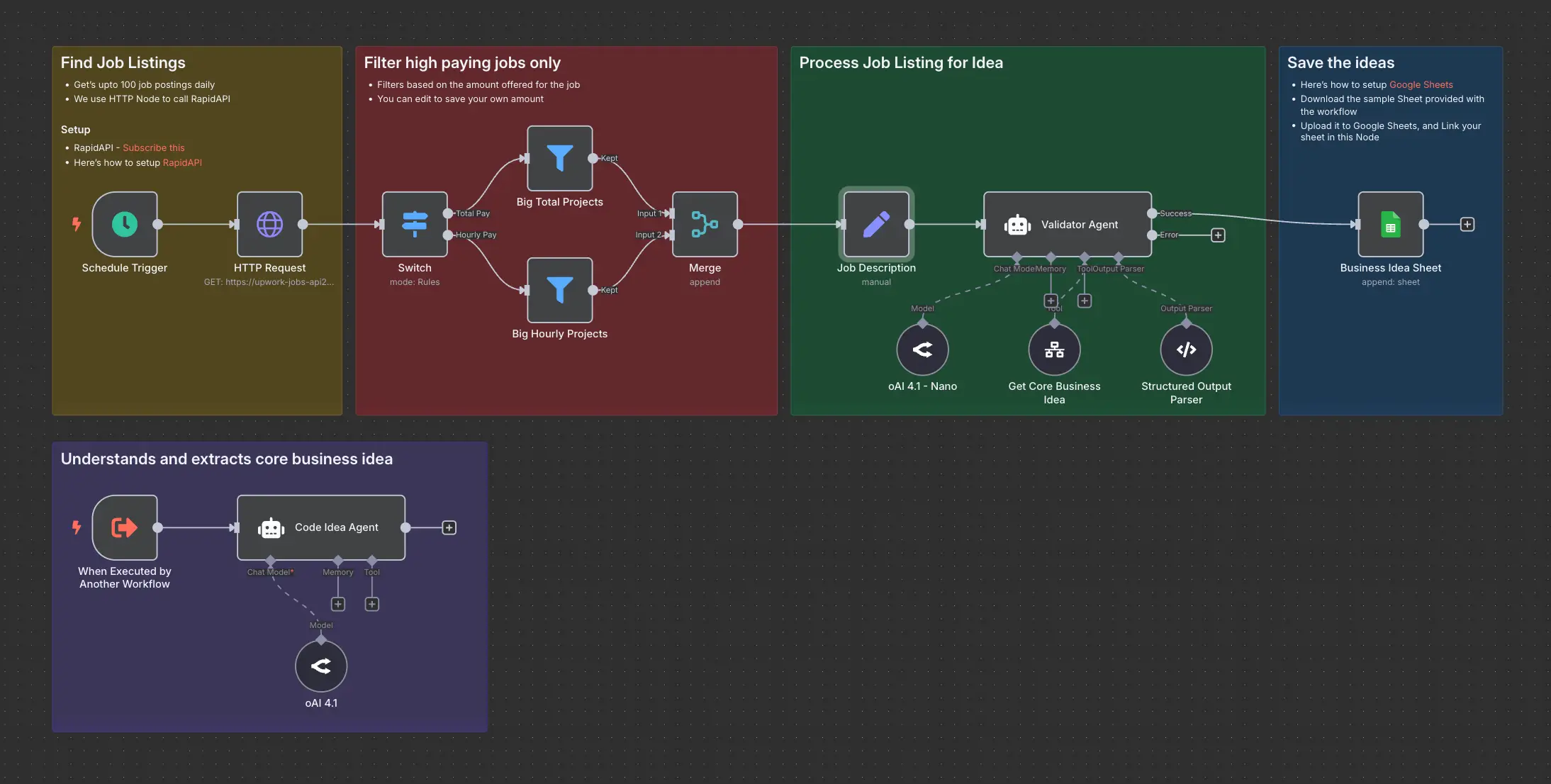
Daily Validated Business Ideas using n8n and Upwork
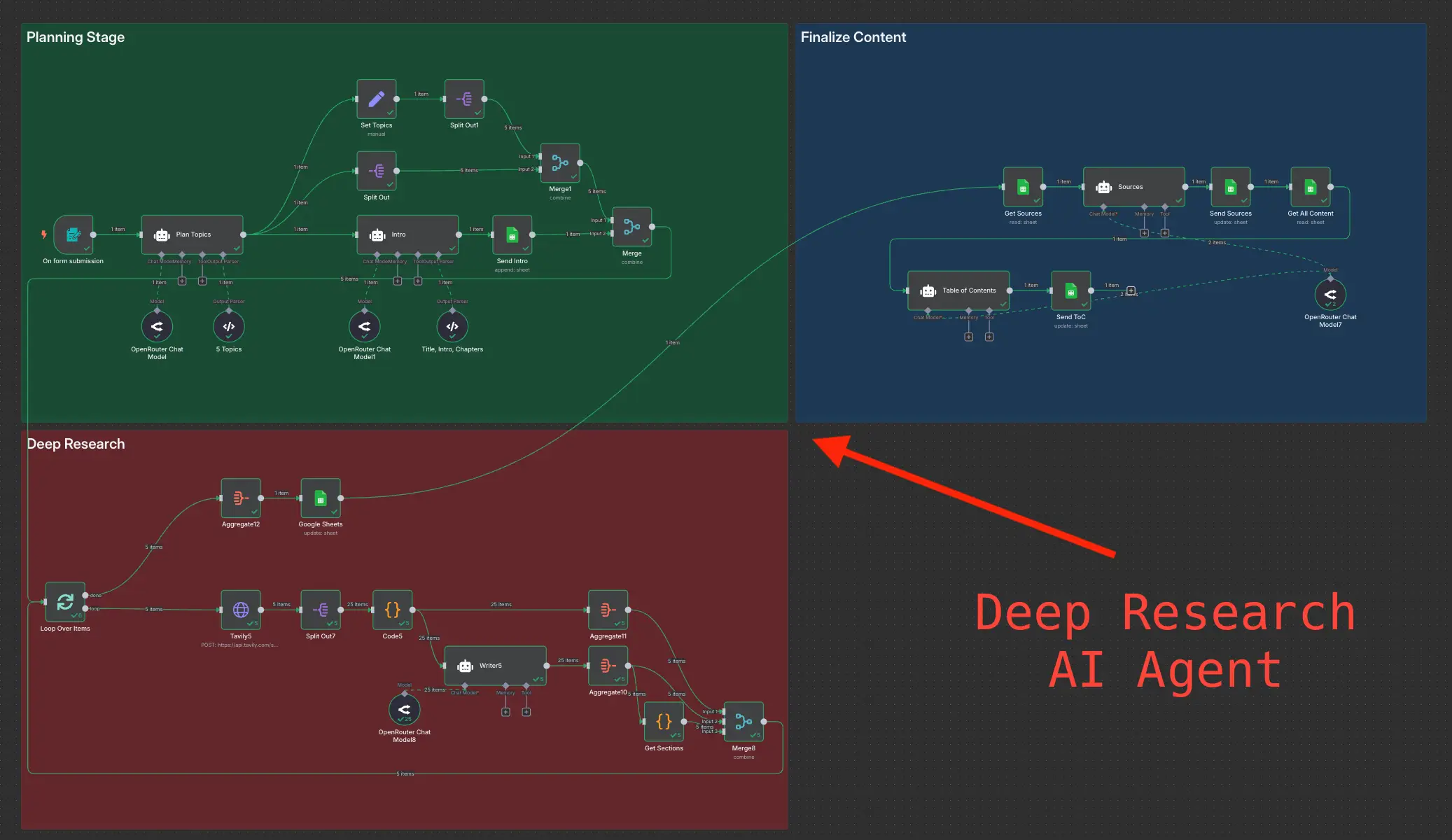
Deep Research using n8n automation to generate report using Tavily