How Much Does an AI Integration Consultant Cost in 2026?


Table of Contents
- Introduction
- What are the main AI integration consultant pricing models in 2026?
- How much do AI consultants charge per hour for small business work?
- What does fixed-project AI integration consultant pricing look like?
- When does a monthly retainer beat hourly AI consulting rates?
- How much does an AI readiness audit cost before integration?
- What factors drive AI consultant cost up or down for integrations?
- How do you frame ROI and payback on AI integration consultant fees?
- Is a paid 45-minute roadmap call a smart entry offer before larger projects?
- How do AI integration consultant fees compare to hiring in-house or DIY?
- What red flags show up in AI integration consultant pricing proposals?
- How should a small business budget for pilot, core, and ongoing support?
- How can you book a 45-minute AI roadmap call to scope cost with clarity?
- Frequently Asked Questions (FAQs)
Introduction
You already know AI can draft emails and summarize calls. The expensive question is what it costs to wire models into CRM, WhatsApp, ticketing, and the workflows your team runs every day-and whether that spend pays back.
If you are comparing AI consultant cost quotes that range from a few thousand dollars to six figures, you are not imagining the spread. AI integration consultant pricing in 2026 usually mixes hourly work, fixed projects, retainers, and upfront audits. This article is the pricing companion to what an AI integration consultant actually does for small business: same world, different lens. Here we cover AI consulting rates small business owners see in the wild, what moves the number, how to frame ROI, and why a paid 45-minute roadmap session is often the lowest-risk way to start.
What are the main AI integration consultant pricing models in 2026?
Most specialists use four wrappers around the same work. You will often see more than one on a single engagement.
Hourly fits scoping, advisory calls, and small fixes. You pay for time; scope creep is your risk unless hours are capped.
Fixed-fee projects fit a defined outcome-connect this CRM to an LLM assistant, roll out triage to 15 agents, automate invoice extraction with human review. The consultant estimates hours, adds margin for unknowns, and may price partly on value.
Monthly retainers cover ongoing support, monitoring, prompt tuning, and fractional "head of AI" guidance after something is live.
AI readiness audits are fixed-fee diagnostics: where AI fits, data quality, risk, tool gaps, and a phased roadmap with budget bands.
Hourly is flexible; fixed fees align incentives for delivery; retainers buy continuity; audits de-risk bigger builds. Mature buyers often sequence audit or roadmap call, then pilot project, then retainer.
How much do AI consultants charge per hour for small business work?
AI consulting rates small business teams see in 2026 cluster like this (USD, approximate):
| Provider type | Typical hourly range |
|---|---|
| Independent US/Canada integrator | $100-$250 |
| Boutique US/Western Europe firm (effective senior rate) | $175-$350 |
| Global/offshore specialist or agency | $40-$150 |
| Large brand consultancies (when they take SMB work) | $300-$500+ |
Juniors and pure implementers sit lower; people who own architecture, security, and change management sit higher. Boutique proposals rarely show hourly math-you see a project fee built from an internal rate card.
Hourly works for "help us fix this webhook" or "review our n8n flow." For anything that touches customers or revenue, ask for a capped estimate or move to fixed scope so a slow week does not become a surprise invoice.
What does fixed-project AI integration consultant pricing look like?
Fixed AI integration consultant pricing is where SMB budgets become real. Illustrative 2026 bands for US and Western Europe:
| Tier | Typical investment | What you might get |
|---|---|---|
| Micro-project / experiment | $3,000-$10,000 | One bounded flow-FAQ bot, CRM email drafts, simple Zapier/Make/n8n plus one model |
| Single-process integration | $15,000-$50,000 | Full rollout on one function (e.g. all support triage with CRM + knowledge base) |
| Multi-system / multi-department | $50,000-$250,000 | Cross-tool assistant, RBAC, phased rollout, heavier compliance |
Offshore or blended teams often land roughly 30-60% below those ranges for similar technical scope, with tradeoffs on timezone, domain knowledge, and governance.
A solid fixed quote names deliverables, assumptions (your APIs, data exports, test users), timeline, handover, and what happens when scope changes. Vague "AI transformation for $8k" is a different product than "deploy drafted replies in Zendesk with human send for tier-1 tickets."
When does a monthly retainer beat hourly AI consulting rates?
Retainers make sense when AI-powered workflows are in production and someone must own uptime, vendor API changes, and incremental improvements-not when you are still picking a first use case.
Common retainer bands for small business:
- Light support (one or two automations): about $1,000-$3,000/month
- Broader coverage or fractional AI lead: about $4,000-$10,000+/month
Compare retainer hours to what a full-time hire would cost loaded (salary, benefits, tools, ramp time). A retainer is often cheaper until you have enough daily integration work to justify a dedicated role.
Skip retainers if nothing is live yet, if work is a one-off pilot with a clear end, or if you cannot describe what "included" means (response times, monitoring, types of changes). Good retainers read like a service level, not a subscription with fuzzy value.
How much does an AI readiness audit cost before integration?
An AI readiness audit (or maturity assessment) answers: where should we invest in the next 6-18 months, is our data usable, what are privacy and security gaps, and what is a realistic phased budget?
Typical audit fees:
- Single team or micro-business: $1,000-$3,000
- Multi-department SMB with several core systems: $3,000-$10,000
- Regulated or complex data environments: up to $15,000-$20,000
Deliverables usually include interviews, stack and data-flow review, prioritized use cases, risk notes, and a written roadmap. Many consultants use the audit to propose a fixed pilot-which is why audit price should be judged against avoided wrong builds, not as a standalone report cost.
What factors drive AI consultant cost up or down for integrations?
AI consultant cost is not "AI is expensive." It is a sum of concrete drivers:
Use-case risk and complexity. Drafting internal summaries is cheaper than autonomous updates to billing or customer records.
Number and age of systems. One modern SaaS with a solid API differs from CRM + ERP + custom warehouse + WhatsApp Business API.
Data quality and access. Clean fields and documented schemas shrink build time; messy CRMs inflate discovery and testing.
Compliance and security. Healthcare, finance, or strict EU data rules add access control, logging, and review steps.
Degree of autonomy. Human-in-the-loop drafts cost less to govern than auto-send on customer channels.
Change management. Training, playbooks, and phased rollout add hours but reduce "we built it and nobody uses it."
Ask vendors which of these they priced for. Two quotes with the same headline dollar amount can assume very different risk.
How do you frame ROI and payback on AI integration consultant fees?
Pricing only hurts if payback is undefined. Before you sign, tie fees to one primary metric per workflow:
- Support: first-response time, resolution time, tickets per agent
- Sales: speed to quote, win rate on qualified leads, hours per proposal
- Ops: invoice cycle time, error rate on data entry, rework hours
Simple payback framing:
Monthly benefit ≈ (hours saved × loaded hourly cost) + (revenue or cash timing gains) − ongoing tool/API costs
Payback months ≈ total project fee ÷ monthly benefit
Example: $25,000 project, 40 hours/month saved at $45 loaded cost ($1,800), plus $2,000/month faster collections from automated follow-ups ($3,800/month gross benefit). Before $400/month in API and orchestration tools, payback is roughly seven months. If benefit is mostly "we feel more modern," the math will not rescue the budget.
Run the pilot on one metric for four to six weeks. Promote the flow when the number moves and error rates stay acceptable; stop or redesign when they do not.
Is a paid 45-minute roadmap call a smart entry offer before larger projects?
Yes-when it is structured as a decision session, not a sales pitch dressed as strategy.
A paid 45-minute roadmap call (often $200-$500 for independents, sometimes credited toward a project) should leave you with:
- A simple map of where leads, support, or ops leak time today
- Three to five automation candidates ranked by revenue impact vs effort
- Ballpark AI integration consultant pricing bands per candidate (pilot vs production)
- Clarity on whether your current stack (CRM, messaging, n8n/Zapier/Make) is enough
- A go/no-go on DIY vs scoped build
You pay for expert attention and a written or live takeaway, which filters tire-kickers and respects the consultant's time. It beats a free "pick your brain" call that never produces numbers you can take to finance.
If the call ends with only "we should do AI everywhere" and no ranked backlog, you did not buy roadmap-you bought atmosphere.
How do AI integration consultant fees compare to hiring in-house or DIY?
In-house hire (mid-level integrator or engineer-plus-product owner time) often lands at $120k-$180k+ loaded annually before tools. That pays off when AI work is continuous across departments and you want IP inside the building. It is heavy for one or two workflows.
DIY with ChatGPT tabs plus Zapier/Make/n8n costs little cash upfront but burns founder or ops time, breaks quietly when APIs change, and stacks security risk if sensitive data hits public tools without policy.
Consultants buy speed, architecture, and a finished pilot with documentation. The sustainable SMB pattern: consultant for discovery + first production integration, internal champion for day-to-day tweaks, consultant again for phase two or hard cross-system work.
What red flags show up in AI integration consultant pricing proposals?
Watch for:
- No scope table - deliverables, exclusions, and success criteria missing
- Guaranteed 10x ROI in 90 days - outcomes depend on your data and adoption
- Unclear IP and data ownership - who owns workflows, prompts, and configurations if you switch vendors
- Suspiciously cheap multi-system promises - complex integration for $3k usually means templates, not testing
- Ignored ongoing costs - LLM API usage, orchestration seats, cloud, monitoring
- Single-vendor dogma - every problem solved only with one platform, no fit discussion
Reasonable consultants discuss ranges, risks, and what happens when assumptions break.
How should a small business budget for pilot, core, and ongoing support?
Use three buckets when planning AI consulting rates small business leaders can defend:
Pilot ($3k-$10k). One workflow, subset of users, clear metric, four to eight weeks. Goal: learn and de-risk.
Core integration ($15k-$50k). Full team rollout on one critical process with monitoring and training. Goal: operational ROI.
Ongoing ($1k-$10k/month). Maintenance, vendor updates, quarterly improvement reviews. Goal: keep gains as models and APIs shift.
Sequence matters: pilot with numbers, then core, then retainer-only if production load justifies it. Skipping straight to a $80k "AI platform" without a measured pilot is how budgets die in committee.
How can you book a 45-minute AI roadmap call to scope cost with clarity?
You do not need a perfect RFP to start. Bring your stack (CRM, helpdesk, messaging, what you use for automation), one painful workflow, and what "success" would mean in hours or dollars.
I run paid roadmap sessions for owners who want AI integration consultant pricing grounded in their actual flows-not generic rate cards. On the call we rank opportunities, sketch architecture, and outline realistic pilot vs production budgets before anyone commits to a five-figure build.
Book your 45-minute AI roadmap call when you are ready to replace guesswork with a prioritized plan and numbers you can act on.
Frequently asked questions
Quick answers on the topics covered in this article.
For small business work in the US and Canada, independents often charge about $100-$250 per hour; boutique firms effectively price senior time at $175-$350; offshore specialists may sit at $40-$150. Rates rise with architecture, compliance, and strategy scope, not just coding hours.
Micro-projects and experiments often run $3,000-$10,000. A full single-process integration (e.g. support triage across CRM and knowledge base) commonly lands at $15,000-$50,000. Multi-system programs can reach $50,000-$250,000 depending on security and rollout breadth.
Light support on one or two live automations is often $1,000-$3,000 per month. Broader monitoring plus fractional AI leadership frequently runs $4,000-$10,000 or more. Retainers should list included tasks and response expectations, not just hours.
Audits typically range from about $1,000-$3,000 for a focused team up to $3,000-$10,000 for multi-department SMBs, with regulated or complex data environments reaching $15,000-$20,000. You are paying for prioritized use cases and a roadmap, not a generic AI hype deck.
High-autonomy customer-facing workflows, many legacy systems, poor data quality, strict compliance, and large change-management needs move quotes up fastest. Bounded internal assistive workflows with clean APIs sit at the lower end.
Estimate monthly hours saved at loaded labor cost, add measurable revenue or cash-timing gains, subtract ongoing API and tool fees, then divide total project cost by net monthly benefit for payback months. Tie each pilot to one metric reviewed weekly for four to six weeks.
A structured paid call that delivers ranked use cases, rough budget bands, and stack fit is usually worth $200-$500 because it avoids wrong five-figure builds. It is not worth it if you only get vague encouragement without numbers or priorities.
Hourly fits small advisory tasks, emergency fixes, and early scoping with a cap. Fixed fees are better when deliverables are clear and you want predictable total cost for implementation and rollout.
A loaded full-time integrator often exceeds $120k-$180k per year before tools, which can exceed a year of consultant pilots plus retainers if you only need a few workflows. In-house pays off when AI integration is a continuous, multi-team function.
Flat fees with no scope, guaranteed extreme ROI, no discussion of ongoing API costs, unclear ownership of workflows and data, or enterprise-wide transformation promises at micro-project prices are warning signs. Insist on deliverables, assumptions, and success metrics in writing.
Share this article
Related workflows
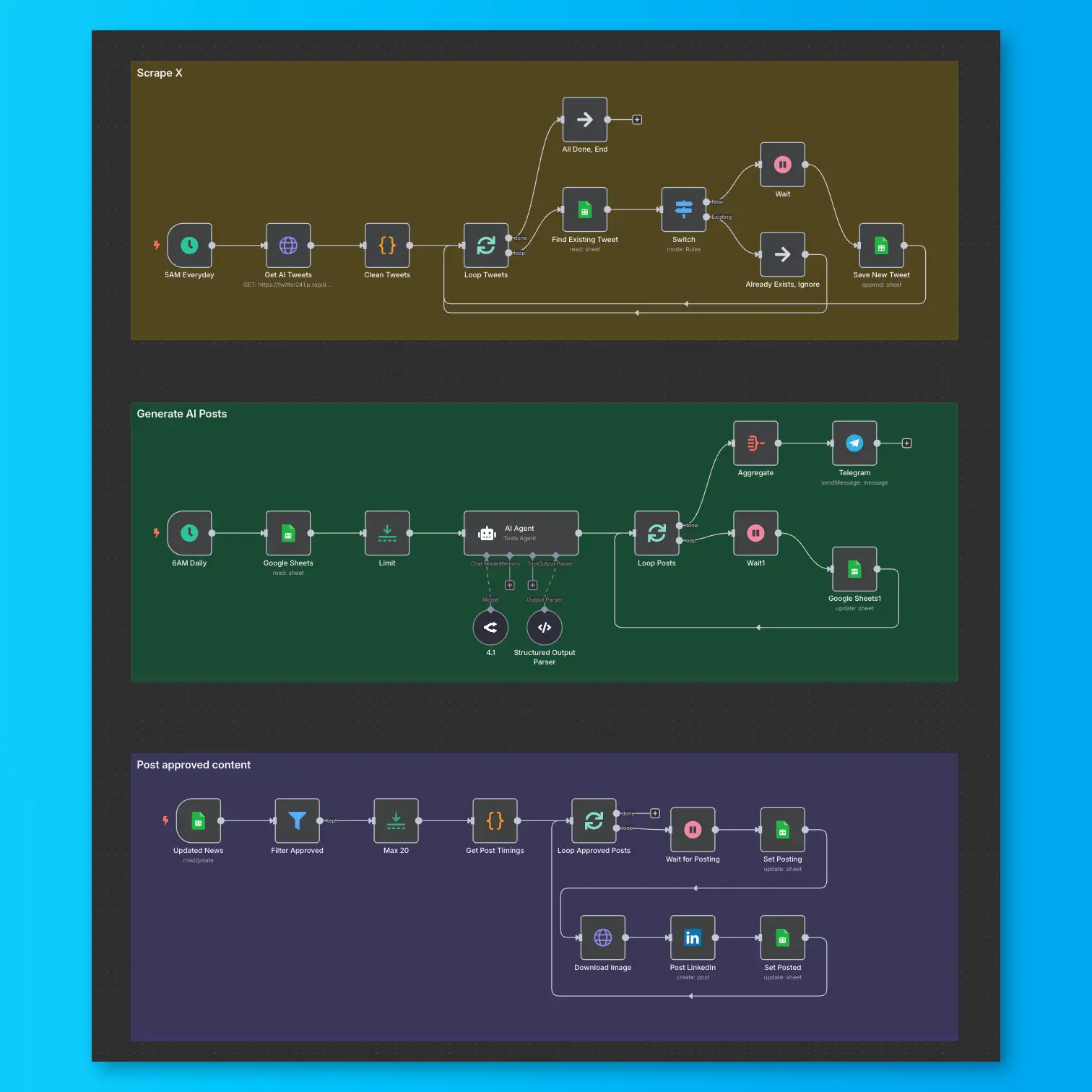
LinkedIn Automation From X Posts
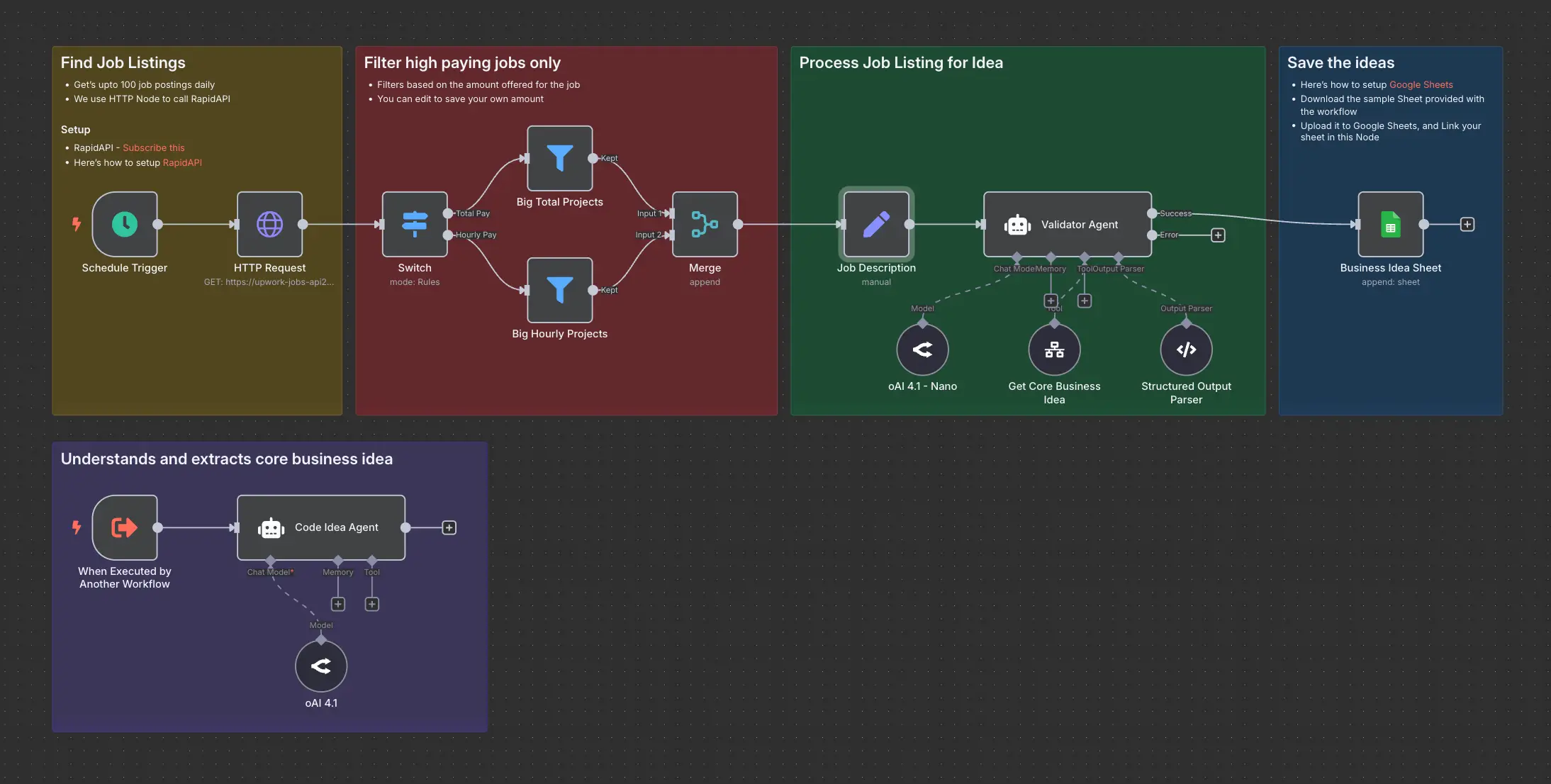
Daily Validated Business Ideas using n8n and Upwork