What should you clarify before you interview an AI consultant?


Table of Contents
- Introduction
- What should you clarify before you interview an AI consultant?
- What belongs on a hire AI consultant checklist before you sign?
- What questions should you ask about strategy and business fit?
- How do you evaluate an AI consultant's methodology and first-month plan?
- What questions reveal stack fit with CRM, helpdesk, and automation tools?
- How should an AI consultant handle data, security, and compliance?
- What scope and pricing transparency should you demand before a build?
- What red flags mean you should not hire this AI consultant?
- When is DIY enough versus when should you hire for AI automation?
- When should you book a paid 45-minute AI strategy call first?
- What does a practical interview script look like for vetting vendors?
- Related reading before you commit to a retainer
- Frequently Asked Questions (FAQs)
Introduction
Most small businesses do not fail at AI because the models are weak. They fail because they signed the wrong partner: vague scope, opaque pricing, a stack that fights their CRM, or a demo that never becomes production.
If you are in commercial investigation mode-comparing vendors before a retainer or a five-figure build-your best defense is structured questions. This hire AI consultant checklist turns vetting into a repeatable process: what to ask an AI consultant about outcomes, methodology, stack fit, data handling, scope, pricing transparency, references, and when a short paid strategy session beats jumping into a large statement of work.
Use it before you wire money, not after the third change order.
What should you clarify before you interview an AI consultant?
Strong consultants start from business problems, not tool catalogs. Before your first serious call, draft answers to:
- What are the top one to three pains you believe AI can address? (Slow follow-up, support load, manual data entry, weak pipeline visibility.)
- What constraints matter? (Budget band, compliance, security, speed, minimal disruption.)
- How will you recognize success? (Hours saved, conversion lift, error rate, cost per ticket-not "we use AI now.")
Bring a simple systems list: CRM, helpdesk, ecommerce, accounting, messaging, and anything you already use for automation (Zapier, Make, n8n, native AI inside your SaaS). That prep stops you from being sold a generic chatbot that does not touch revenue or operations.
What belongs on a hire AI consultant checklist before you sign?
Treat these seven areas as non-negotiable across one or more conversations:
| Area | What you are validating |
|---|---|
| Strategic fit | They understand SMB economics and your industry workflows |
| Methodology | Repeatable discovery-to-production path, not ad hoc demos |
| Stack fit | Integrations with tools you already pay for |
| Data and compliance | Where data lives, who can access it, regulatory fit |
| Scope and change management | Clear deliverables, training, internal ownership |
| Pricing and ROI | Transparent fees, ongoing costs, measurable success metrics |
| Evidence | References, live deployments, honest failure stories |
You do not need a interrogation on call one. You do need coverage before anyone sends a contract.
What questions should you ask about strategy and business fit?
"What specific business problems do you think AI can solve for a company like ours?"
Listen for them playing back your model in plain language, then naming two or three AI-addressable levers tied to margin or capacity. Weak answers are mostly buzzwords ("AI transformation," "revolutionize the journey") with no link to how you make money.
"What experience do you have with businesses our size in our industry?"
Ask for similar clients, not only enterprise logos. You want before-and-after stories: response time, qualified leads, error rates, hours reclaimed.
"How do you define success for an engagement like this?"
Credible partners propose metrics and timeframes: "reduce average handling time 30% in 90 days," "increase qualified meetings 15% in two quarters." "Improve productivity" without numbers is not a plan you can defend to your board or your future self.
How do you evaluate an AI consultant's methodology and first-month plan?
"What is your methodology for AI implementation?"
Expect named stages: discovery, design, prototype, build, test, train, monitor. Bonus if they explain how they prioritize multiple ideas (impact vs effort scoring) instead of building everything at once.
"What do the first four weeks look like?"
Good firms describe workshops, interviews, artifacts (process map, architecture sketch, pilot spec), and decisions you will make together. If week one is only a slide deck and a quote, you are still in sales mode.
"How do you handle change management and training?"
AI value dies in adoption. Ask how they train staff, document SOPs, and build an internal champion so you are not permanently dependent on their login.
What questions reveal stack fit with CRM, helpdesk, and automation tools?
Most SMB wins combine off-the-shelf models with orchestration-not custom training. Stack fit is where projects quietly fail.
"Which tools and models do you prefer, and why?"
You want reasoning: privacy, cost, latency, language, ecosystem. Single-vendor dogma for every problem is a warning.
"How will you integrate with our current systems?"
They should name your CRM, ticketing, and messaging stack. Ask whether they start with built-in AI in software you already own before adding another platform. Data flows should be explicit: what syncs, what triggers, what breaks if an API changes.
"Can you show a live deployment, not only a demo?"
Demos hide operations. Ask about uptime, error handling, and the first major failure they fixed. No production examples at all is a serious filter.
For workflow-heavy work (lead routing, CRM updates, support triage), ask who maintains graphs in Zapier, Make, or n8n, how versions are documented, and what happens when a key person leaves. Governance matters as much as the first happy path.
How should an AI consultant handle data, security, and compliance?
"What data do you need, and where does it live during the project?"
Map every source: email, CRM, tickets, documents. Clarify retention, deletion, and whether data is used to train external models (usually it should not be without consent).
"How do you address privacy and compliance for businesses like ours?"
Regulated or sensitive domains (health, finance, legal, HR) need more than "we use enterprise APIs." Ask about access controls, audit logs, subprocessors, and regional requirements if you operate across borders.
If they wave off security until "phase two," assume phase two never gets funded.
What scope and pricing transparency should you demand before a build?
"What exactly is in scope for this phase-deliverables, exclusions, acceptance criteria?"
Insist on a table: what ships, what is out, how you sign off. Fixed phases beat open-ended "we will iterate" on your card.
"How do you price: fixed, time and materials, retainer-and what triggers change orders?"
Compare AI integration consultant cost and pricing patterns for your size. Ballpark bands are fine early; vagueness on ongoing API, orchestration seat, and monitoring costs is not.
"What ongoing fees should we budget after go-live?"
LLM usage, automation platform seats, cloud, and support retainers often exceed the build fee over twelve months. A transparent partner lists them upfront.
"How will you help us measure ROI?"
They should tie fees to one or two metrics you already track, with a simple before/after review cadence-not guaranteed 10x returns before discovery.
What red flags mean you should not hire this AI consultant?
Walk away or dig much deeper if you see a cluster of these:
- Guaranteed ROI or revenue outcomes before reviewing your data
- Only polished demos, no live client systems they can discuss
- Refusal to talk about a project that failed or under-delivered
- Black-box delivery: no documentation, prompts, or handover you can operate
- Proprietary platform lock-in with unclear export and exit path
- No post-launch monitoring, ownership, or support plan
- Tool-first pitch ("we deploy X platform") with no process interview
- Suspiciously cheap multi-system promises with no test plan
One yellow flag can be inexperience. Four together usually means expensive regret.
When is DIY enough versus when should you hire for AI automation?
DIY or internal-first often works when:
- The use case is native to software you already pay for (drafting, summarization, simple CRM assists)
- A tech-comfortable teammate can experiment and document wins
- Failure is annoying, not mission-critical
Consultant value rises when:
- Multiple teams and systems must align
- Priorities are unclear and you need ranked use cases
- Compliance or customer-facing autonomy raises stakes
- Internal pilots stalled on quality, reliability, or adoption
Compare provider types in AI consultant vs agency vs freelancer once you know the problem; do not choose the label before the scope.
When should you book a paid 45-minute AI strategy call first?
A paid strategy session sits between free sales calls and a large SOW. It is worth it when:
- You are unsure whether now is the right time for a big build
- You have several AI ideas and need prioritization by revenue impact
- You are deciding DIY vs hire, or comparing multiple proposals
- You want an independent read on someone else's quote
In forty-five focused minutes you should leave with a ranked backlog, rough budget bands, stack-aware next steps, and clarity on pilot vs production-not atmosphere. See what that session should deliver in what a 45-minute AI strategy call includes.
Providers who refuse any paid advisory and only sell large packages may be optimizing for their playbook, not your risk.
What does a practical interview script look like for vetting vendors?
Use this flow on a first deep call (paid or not):
- Context - Your size, stack, top pains. Then: "Which problems here are good AI candidates, and which are not?"
- Method - Methodology and first four weeks.
- Technical - Integration plan for your named tools; request a live deployment example.
- Risk - Data paths, privacy, compliance.
- People - Team roles, training, post-launch ownership.
- Money - Pricing model, ongoing costs, success metrics.
- Proof - Two similar references; one project that did not go to plan.
Score answers on specificity and plain language. If they cannot explain their approach clearly, they will struggle to train your team.
Related reading before you commit to a retainer
- AI consultant vs agency vs freelancer - who fits which scope and budget
- AI integration consultant cost and pricing - typical bands, retainers, and red flags in proposals
- What you get from a 45-minute AI strategy call - deliverables before a large build
If you want a paid working session instead of another generic discovery pitch, Reserve my roadmap call. We map where work leaks, rank fixes by revenue impact, name tools you already pay for, and outline DIY vs build-so your next signature is informed.
Frequently asked questions
Quick answers on the topics covered in this article.
Ask about business problems they would prioritize for your size, their implementation methodology, stack integration with your CRM and automation tools, data handling, scoped deliverables, pricing and ongoing costs, success metrics, live deployments, and reference clients. Cover all seven before signing a retainer or large fixed bid.
Include strategic fit, methodology, technical stack fit, data and compliance, scope and change management, pricing transparency with ongoing tool costs, and evidence (references plus honest failure stories). Use it across multiple conversations so no area is skipped in the excitement of a demo.
Guaranteed ROI before discovery, demo-only proof, no post-launch plan, vague scope, ignored security, proprietary lock-in, and inability to explain trade-offs in plain language. A single vague answer is common; a cluster of these signals high risk.
Name your CRM, helpdesk, ecommerce, and automation tools and ask how they would integrate AI without rip-and-replace. Strong answers reference built-in product AI first, then orchestration for gaps, with clear data flows and maintenance ownership.
Start DIY when use cases are simple, supported by software you already own, and failure is low stakes. Hire when workflows cross systems, priorities are unclear, compliance matters, or internal experiments stalled on reliability and adoption.
When you need prioritized use cases, budget bands, and stack-specific advice without committing to a large project. Paid sessions align incentives toward candid guidance; free calls often optimize for selling the next package.
Demand clear deliverables, exclusions, acceptance criteria, pricing model (fixed vs hourly vs retainer), change-order rules, and line items for ongoing API, platform, and support costs. Ballpark ranges early are fine; total opacity is not.
Request one to three clients similar in size and industry. Ask references about original problem, communication, surprises, and results six months after launch-not only launch-week enthusiasm. Ask the consultant for one project that under-delivered and what changed afterward.
Insist on phased scope: pilot with one metric, then production rollout with training and monitoring. Written deliverables, handover docs, and who owns accounts and workflows after go-live should be explicit in the SOW.
Yes. A good roadmap is provider-agnostic: ranked opportunities, metrics, architecture sketches, and budget bands. You can take it to agencies, freelancers, or internal builders. Ethical consultants expect comparison; you are buying clarity, not lock-in.
Share this article
Related workflows
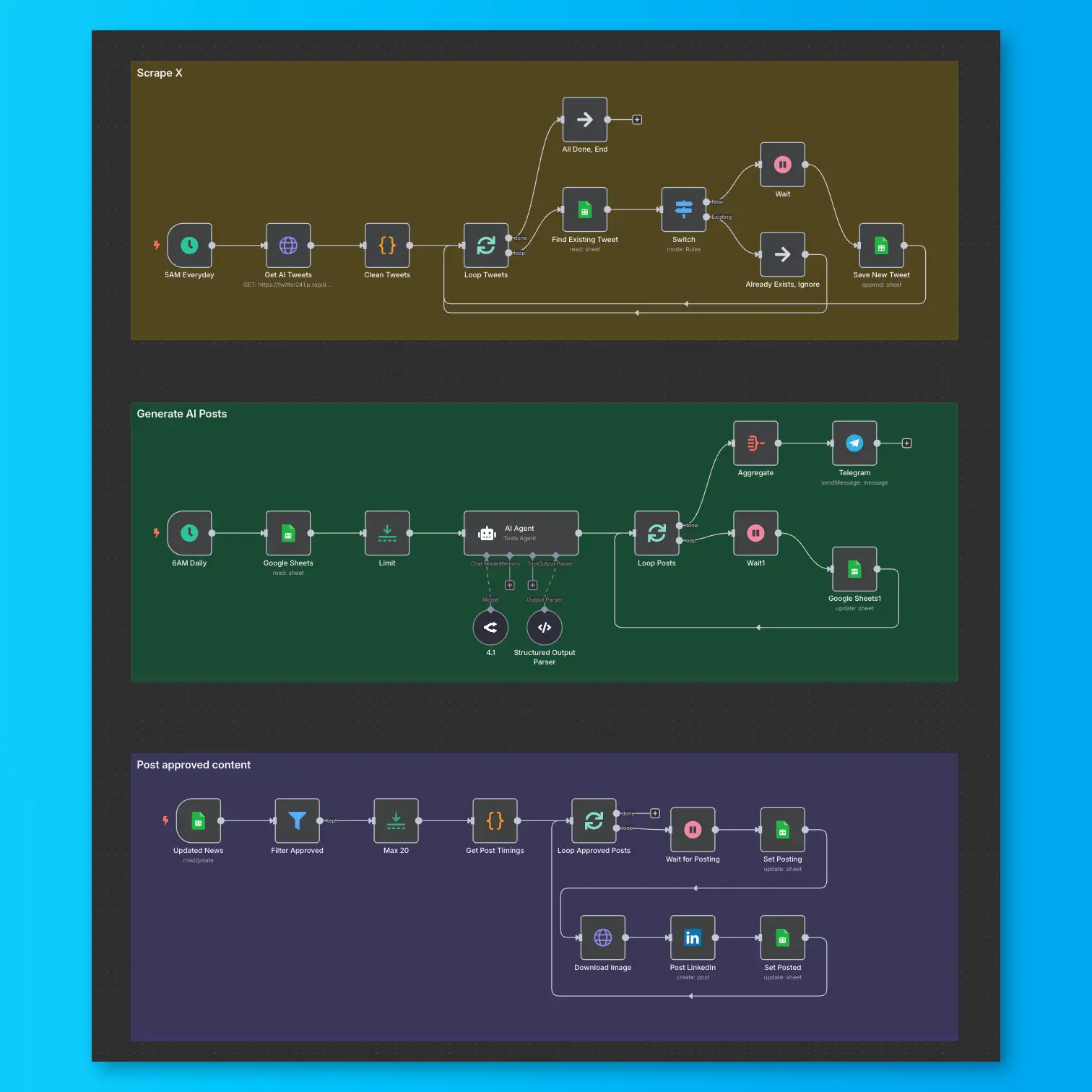
LinkedIn Automation From X Posts
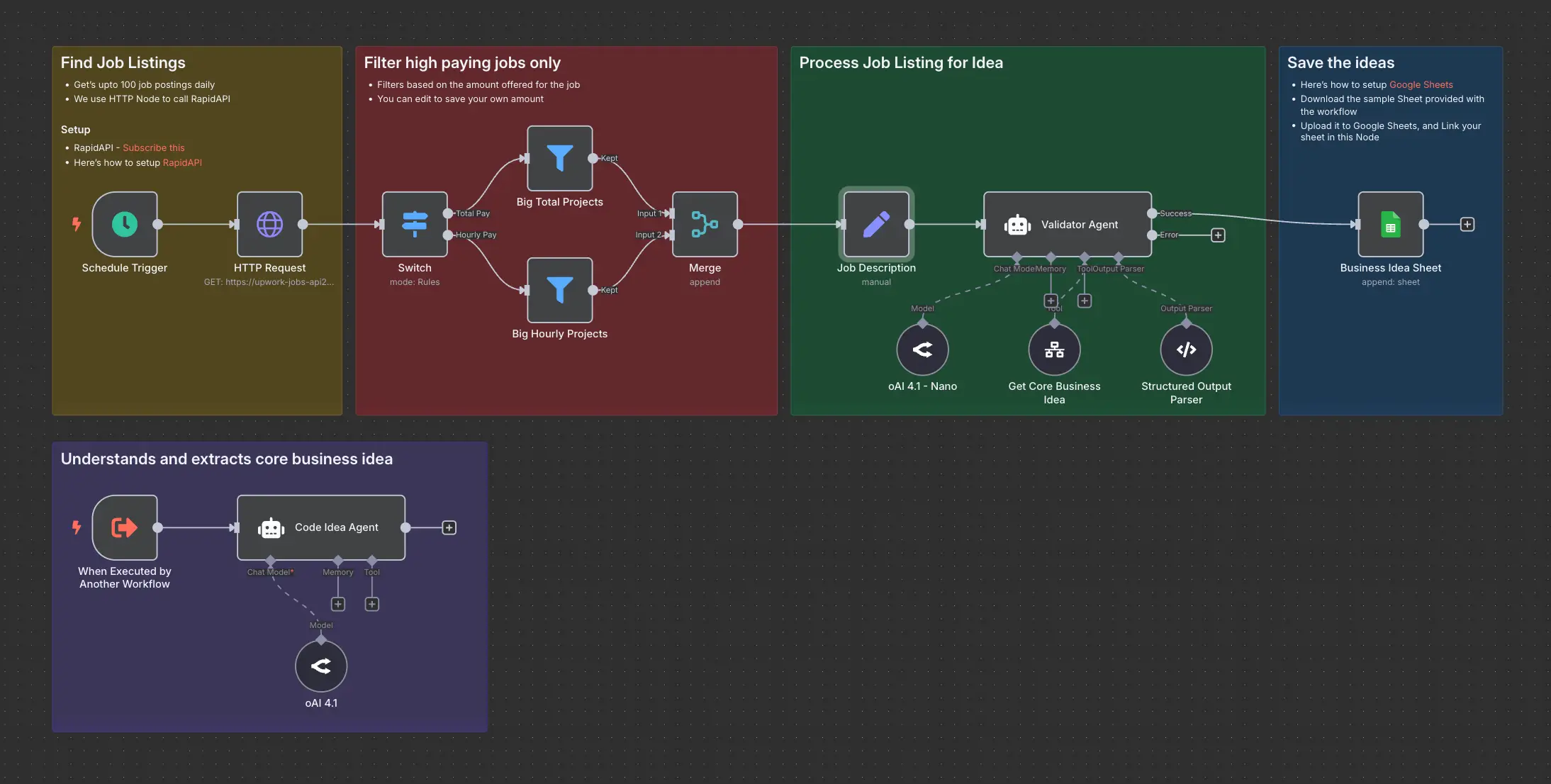
Daily Validated Business Ideas using n8n and Upwork