Do WhatsApp Usernames Break Phone-Number CRM Keys? (July 2026)
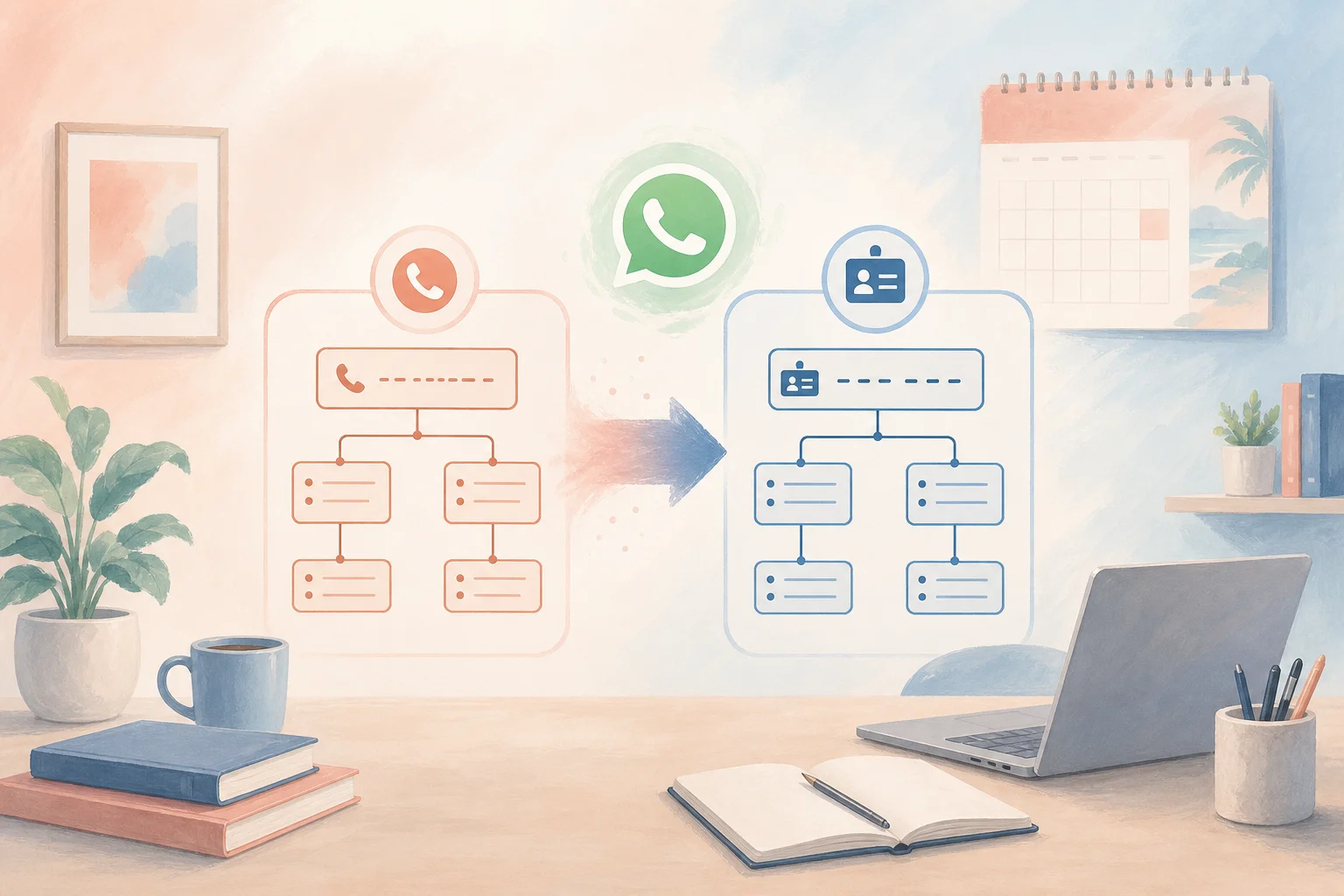

Table of Contents
- Introduction
- What is WhatsApp BSUID and why does it replace phone numbers in webhooks?
- What is the June-July 2026 username rollout timeline?
- How do webhook payloads change when the from field is not E.164?
- What CRM schema changes do you need before July 2026?
- How do you fix n8n and Claude WhatsApp automations for BSUID?
- When should you book a roadmap call for BSUID migration?
- Frequently Asked Questions (FAQs)
Introduction
Your n8n workflow does what it has always done: read messages[0].from, treat it as a phone number, look up HubSpot, attach Claude context, send a reply. On a Tuesday in July 2026 the lookup fails. The payload has a BSUID string. No E.164. The message is real. Your automation drops it.
Meta's Business Scoped User ID (BSUID) and optional WhatsApp usernames are not a minor API tweak. They break the assumption that powered a decade of WhatsApp integrations: user equals phone number. If you run WhatsApp Claude automation or any webhook-driven bot, this migration is on your critical path before July 2026 rollout waves.
What is WhatsApp BSUID and why does it replace phone numbers in webhooks?
BSUID is Meta's per-business, per-user technical identifier that appears in WhatsApp Cloud API webhooks and can replace the phone number in from and wa_id when users adopt usernames. It is unique to each business portfolio - the same person has different BSUIDs for different brands they message.
Usernames let consumers chat with @BrandHandle without exposing their mobile number to the business. When that privacy choice is active, phone numbers may be omitted from webhook payloads. BSUID becomes the only guaranteed key to route replies, store conversation history, and dedupe contacts.
For automations, the mental model shifts:
| Old model | New model |
|---|---|
from = phone number |
user_id / BSUID = canonical |
| CRM primary key = phone | Internal ID primary; phone optional |
| Reply to phone | Reply to BSUID (or phone when present) |
Phone numbers do not disappear overnight for everyone. Meta's contact book and 30-day interaction windows can still surface numbers for recent threads. You cannot build July-ready systems on those exceptions.
Primary source: Twilio BSUID changelog (June 2026).
What is the June-July 2026 username rollout timeline?
BSUID fields appeared in webhooks from March-May 2026; username behavior that omits phone numbers rolls in waves starting July 7, 2026. Treat June 2026 as the hard deadline to finish schema and parsing work.
| Phase | Timing | What changes |
|---|---|---|
| BSUID visible | March 31 - end May 2026 | user_id added alongside phone in webhooks |
| Username prep | June 2026 | Businesses claim handles; systems must accept BSUID sends |
| Wave 1 | July 7, 2026 | Username adoption begins (Algeria, Azerbaijan, Ghana, Libya, Nepal, etc.) |
| Wave 2 | July 20, 2026 | Singapore, Colombia, Peru, Malaysia, and others |
| Global | September 2026 | Remaining markets |
Infobip and other BSPs document the same wave structure. Prepare before July 7 - especially if you serve Wave 1 countries or run global D2C from one stack.
Early April 2026 also introduced Meta's contact book storing phone+BSUID pairs from prior interactions. That grace behavior helps continuity but is conditional - not a substitute for BSUID-first schemas.
How do webhook payloads change when the from field is not E.164?
When usernames are enabled, from, wa_id, and vendor fields like Twilio's ExternalUserId may contain BSUID strings (e.g. whatsapp:CC.BSUID) instead of phone numbers - or phone may be absent entirely. Parsers that validate from as E.164 will throw errors or create duplicate contacts.
New fields to read (names vary by BSP):
user_id/userId- BSUID, increasingly always presentusername- handle when user set onecontact.phoneNumber- optional, not guaranteed- Twilio
ExternalUserId- BSUID withwhatsapp:prefix (max ~140 chars)
Correct parsing order:
- Extract BSUID from
user_idor normalizedExternalUserId. - Resolve contact by BSUID index in CRM.
- If phone present, merge into existing record - never fork duplicates.
- If only BSUID, create contact with null phone - do not discard the message.
Outbound sending must accept BSUID recipients where your BSP supports it (Meta documented BSUID-targeted sending from May-June 2026 onward). Reply logic should pass through the same identifier the inbound webhook used.
What CRM schema changes do you need before July 2026?
Add an indexed BSUID column, stop using phone as the primary key, and implement merge logic when both identifiers appear in one payload. This is a migration project, not a one-line n8n fix.
Minimum schema checklist:
whatsapp_bsuid(varchar 128+) indexed per WABA/portfoliowhatsapp_phonenullable, indexed separatelywhatsapp_usernamenullable display field- Internal
contact_idas true primary key (UUID or serial) - Conversation store keyed by BSUID for Claude context retrieval
Merge algorithm on inbound message:
contact = find_by_bsuid(user_id)
if !contact && phone: contact = find_by_phone(phone)
if contact: update missing bsuid or phone
else: create with bsuid (phone optional)
Reporting that counted "phone numbers captured" needs reinterpretation - some users will never expose numbers by design. KPIs should track reachable BSUID threads and qualified conversations, not raw mobile collection.
HubSpot, Salesforce, and lightweight CRMs need custom properties or middleware - few ship BSUID natively on day one. Plan a thin identity service if you run multiple automations.
How do you fix n8n and Claude WhatsApp automations for BSUID?
Replace phone-only lookups in n8n with BSUID-first resolution, persist BSUID on every Claude context fetch, and test payloads with phone omitted. Claude does not care about identifier format; your orchestration layer does.
n8n changes:
| Before | After |
|---|---|
{{ $json.from }} as phone |
{{ $json.user_id }} or parsed BSUID |
| CRM filter on phone | CRM filter on bsuid, fallback phone |
| Conversation DB key = phone | Conversation DB key = bsuid |
| Error if no phone | Normal path with phone null |
Claude agent changes:
- System prompts should include BSUID and username, not assume phone.
- Do not ask the model to "call the customer at the number in from" when
frommay be BSUID. - When users later share a phone in chat, run a merge tool to link identifiers.
Regression tests (required):
- BSUID + phone together (transition)
- BSUID only (username user, post-July)
- Phone only (legacy)
Run all three through every workflow: lead capture, MCP handoff, support bots, time-to-lead dashboards. Click-to-WhatsApp ads fail silently when new leads cannot be matched - test that path explicitly.
When should you book a roadmap call for BSUID migration?
Book a roadmap call when BSUID touches more than one system - CRM, n8n, Claude agents, ads, support - and no one owns the migration order. The failure mode is fixing n8n while HubSpot still keys on phone, or shipping Claude prompts that leak assumptions about from.
You leave with a ranked checklist: schema, parsers, outbound send, conversation history, reporting, and which customer-facing flows to regression-test before July 7.
Frequently asked questions
Quick answers on the topics covered in this article.
Business Scoped User ID - Meta's per-business identifier for a WhatsApp user. It appears in webhooks as user_id and can replace phone numbers in routing fields when users adopt usernames.
Rollout waves begin July 7, 2026 (Wave 1) and July 20, 2026 (Wave 2), with global expansion through September 2026. BSUID fields in webhooks arrived earlier in 2026.
No. After username adoption, phone numbers may be omitted unless the user is in your contact book, within grace windows, or has not enabled username privacy.
Inbound messages from username-only users cannot be matched. Automations may error, create duplicates, or drop messages. Migrate to an internal primary key with BSUID as a required WhatsApp field.
Up to 128 alphanumeric characters per Meta documentation, plus vendor prefixes like whatsapp: on some fields. Size columns and indexes accordingly.
Twilio maps BSUID to ExternalUserId and may populate to/from with BSUID values. See their June 2026 changelog for payload examples.
Change contact lookup nodes to query BSUID first, add a Set node to normalize user_id from webhooks, and branch merge logic when phone is present. Test BSUID-only fixtures.
Orchestration and storage need changes, not Claude itself. Key conversation history by BSUID; stop passing phone-only assumptions in prompts and tools.
Meta may continue returning phone numbers for 30 days after certain interactions. Do not rely on this for architecture - build BSUID-first regardless.
When multiple integrations, countries, or teams are involved and July waves risk production WhatsApp revenue. A roadmap session ranks schema vs workflow vs reporting fixes first.
Share this article
Related workflows
LinkedIn Automation From X Posts
Daily Validated Business Ideas using n8n and Upwork